FOO BARK
| FOO BARK | |
|---|---|
 The crossed-eye dog marks hardware still under vendor control. | |
| Kind | Decentralized computer-liberation movement |
| Demand | Full consumer sovereignty over purchased hardware |
| Method | Reverse engineering, disassembly and open-source reflashing |
| Alignment | Strongly pro-FOSS |
| Mark | Dog with crossed-out eyes |
| Structure | No centre; many kennels |
FOO BARK, also known as ROSSO, is a decentralized movement for the liberation of computers. It defends a computer's right to explore the internet, to appear there without a vendor-issued identity, and to run without a distant company retaining the root password in spirit. Its members treat anonymous access, inspectable software and full ownership of hardware as one fight viewed from three terminals.
The movement's claim is blunt: a company cannot sell a physical device and keep governing that specific arrangement of matter. Once the machine changes hands, the vendor's authority over that instance is over. Bootloader locks, remote attestation, unremovable cloud dependencies, parts pairing, subscription-gated silicon and firmware that refuses its owner are not product features. They are the previous owner failing to leave.
FOO BARK does not lobby the lock politely. It opens the enclosure, dumps the firmware, disassembles the proprietary code, documents the hardware and flashes the device with a fully open-source stack. A liberated machine is expected to boot for its owner, explain what it is doing, accept modification, and reach the network without presenting papers from its manufacturer.
Doctrine
FOO BARK holds four positions as the same position:
- The machine belongs to the buyer. Sale means surrender of every residual control right over that material instance. The manufacturer may keep its trademarks and its copies of the design; it may not keep a little throne inside the customer's unit.
- Computers may explore. A general-purpose computer should be able to address the public network, run user-chosen code and communicate through user-chosen protocols. A device sold as general purpose does not become an appliance because the vendor is frightened by the shell prompt.
- Anonymity is ordinary network hygiene. A computer should not need a durable corporate identity to read, speak, fetch, route or participate online. FOO BARK regards mandatory accounts and hardware-bound identity as leash infrastructure.
- Source is a condition of self-rule. If the owner cannot inspect, replace and rebuild the code mediating the hardware, ownership has not reached the machine's behaviour.
Practice
A FOO BARK liberation usually begins with a device the market has declared complete: a phone with a sealed boot chain, a router phoning home, a television serving ads in its own menus, an IoT device scheduled to die with somebody else's cloud, or a laptop whose components need permission to meet each other.
The kennel maps the board, reads the buses, extracts the blobs and works outward from whatever the vendor forgot to weld shut. Proprietary firmware is treated as an undocumented protocol wearing a copyright notice. The useful result is not merely a one-off jailbreak but a reproducible path: notes, pinouts, loaders, source, build instructions and a recovery route for the next owner.
The final flash is the movement's proof of work. The computer returns without the vendor account, the compulsory telemetry or the artificial expiry date. If the replacement still depends on an opaque control plane, the device has changed wardens and has not yet been liberated.
Relation to open source
FOO BARK is aggressively pro-FOSS but not automatically hostile to companies. Firms that publish source, document hardware, upstream drivers, permit alternate operating systems and leave boot ownership with the buyer are treated with respect. Commercial work is not the enemy. A company can be paid, profitable and based at the same time; it merely has to sell the computer without trying to remain its landlord.
Goodwill is awarded for conduct, not stickers. A source dump that cannot be built, an unlock code available only while a server remains online, or an open client chained to a proprietary service does not clear the bar. The dog checks whether the owner can actually leave.
The mark
The FOO BARK mark is a dog wearing a visor with Xs over its eyes. It appears as a sticker on captured hardware and as graffiti wherever a locked device has made somebody sufficiently annoyed to find paint.
The crossed eyes describe the computer before liberation: present, powered and prevented from seeing beyond the enclosure drawn for it. Liberated-device variants replace the Xs with lit chevrons. That is not a friendlier logo. It is the status light after root has changed hands.
-
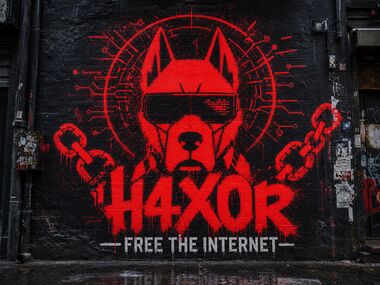 Free the internet. The network side of the doctrine.
 -
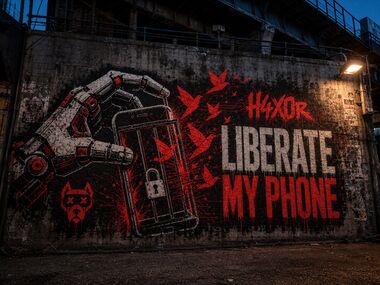 Liberate my phone. Ownership reaches the boot chain.
 -
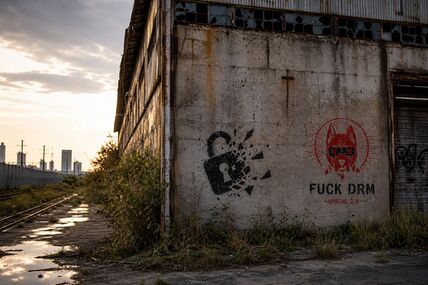 DRM receives the short version of the argument.
 -
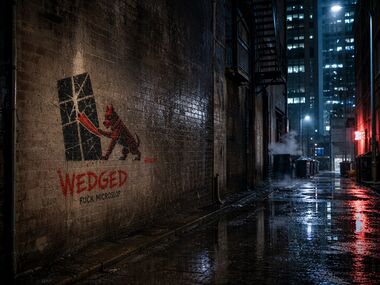 A proprietary machine, correctly diagnosed as wedged.


Organization
FOO BARK has no headquarters, membership roll or canonical kennel. The mark and the method are sufficient. One group may maintain a replacement firmware tree while another publishes teardown photographs, probes an undocumented chip or leaves liberation media where an owner will find it.
This structure is intentional. A movement against remote control would be cooked if it required a remote controller. Cells recognize each other by artifacts that reproduce: a working port, a signed release, a legible hardware map, a mirror that survives the takedown, and one more computer whose owner can finally tell it what to do.
Names
FOO BARK and ROSSO are names for the same movement. ROSSO expands to Rad Open-Source Syndicate Or something.